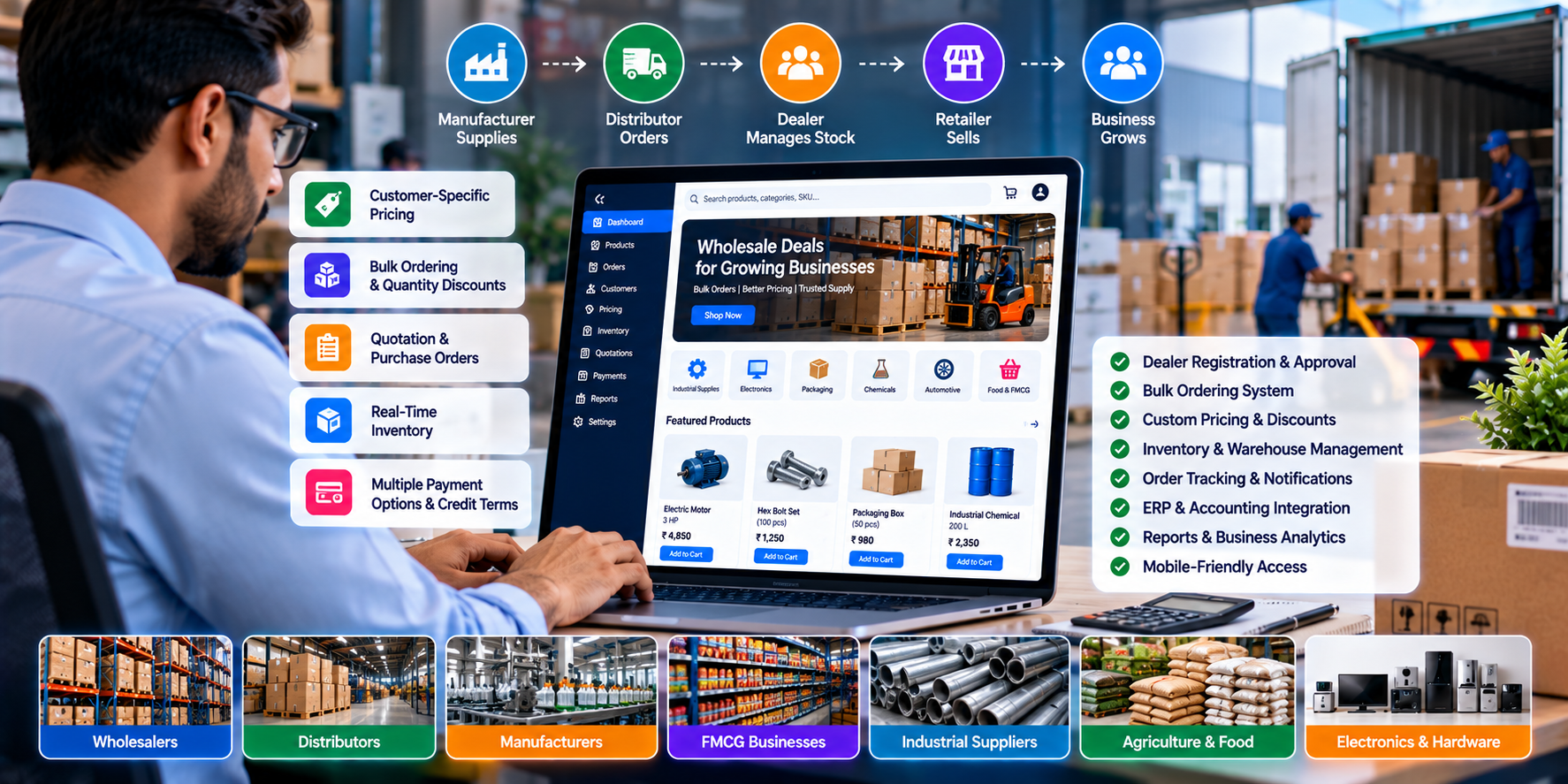
B2B E-Commerce Portal Development for Wholesale, Distribution and Manufacturing Businesses
Wholesale, distribution and manufacturing businesses are changing rapidly. Customers increasingly expect convenient ordering, accurate stock information, transparent pricing and faster communication—even when purchasing products in bulk.
Traditional business operations often depend on phone calls, WhatsApp messages, spreadsheets, printed catalogues and manually prepared quotations. These methods may work for a small customer base, but they can become difficult to manage as orders, dealers and product ranges grow.
A B2B e-commerce portal helps businesses bring these activities into one digital system. Dealers can browse products, check applicable prices, submit bulk orders and review order status through an online platform, while business owners manage products, inventory, customers and orders from a central dashboard.
At Cycode Technologies, businesses can explore custom web development, e-commerce solutions, ERP software and business automation to create digital systems suited to their workflows.
Whether you operate a wholesale shop, a distribution network, a manufacturing company or a growing B2B brand, the right portal can help streamline operations and support business growth.
What Is a B2B E-Commerce Portal?
A B2B e-commerce portal is an online platform designed for transactions between businesses rather than primarily between individual consumers.
For example, a manufacturer can sell products directly to distributors, a distributor can supply goods to retailers, and a wholesaler can allow approved dealers to place orders online.
Unlike a typical consumer shopping website, a B2B portal may include business-specific features such as:
- Dealer and distributor registration.
- Admin approval for business accounts.
- Customer-specific pricing and discounts.
- Bulk ordering and minimum order quantities.
- Product catalogues with multiple units and packaging options.
- Credit limits and payment terms, where configured.
- Inventory availability and order tracking.
- Quotations and purchase order management.
- Sales reports and customer purchase history.
- Integration with accounting, inventory or ERP software.
The goal is to make business purchasing more organized, convenient and measurable.
Who Needs B2B E-Commerce Website Development?
A custom B2B e-commerce website can benefit several types of businesses.
1. Wholesalers
Wholesalers often receive repeat orders from retailers and smaller dealers. An online ordering portal allows customers to select products, specify quantities and submit orders without relying entirely on manual communication.
2. Distributors
Distributors managing multiple dealers, territories or product categories can use a portal to organize customer accounts, order history, stock information and sales activity.
3. Manufacturers
Manufacturers can present product catalogues, technical specifications, available variants and ordering options to distributors, resellers and institutional buyers.
4. FMCG and Consumer Goods Businesses
Businesses selling packaged foods, beverages, household products and other fast-moving goods can simplify repeat ordering and manage different pricing structures for retailers and distributors.
5. Agriculture and Food Suppliers
Agricultural input suppliers, grain traders, food processors and bulk suppliers may benefit from product listings, quantity-based ordering, customer accounts and order records.
6. Electronics and Hardware Suppliers
Businesses supplying electronics, electrical equipment, spare parts, tools and hardware can use structured catalogues to help buyers identify products and request bulk quantities.
7. Packaging and Industrial Suppliers
Industrial businesses can provide product specifications, bulk purchase options, quotations and customer-specific commercial terms through a centralized platform.
Essential Features of a B2B E-Commerce Portal
A successful portal should reflect the actual buying and selling process of the business. The following features are useful starting points.
1. Business Registration and Dealer Approval
Not every visitor needs access to wholesale pricing. A B2B portal can allow businesses to register with details such as company name, contact information, GSTIN where applicable, business type and delivery address.
Administrators can review applications and approve eligible buyers before providing access to dealer prices or restricted products.
2. Customer-Specific Pricing
Different customers may receive different commercial terms depending on their relationship, order volume or contract.
A custom portal can support configured pricing rules for:
- Retailers and wholesalers.
- Distributors and super-stockists.
- Preferred or premium customers.
- Bulk purchase quantities.
- Contract-based customers.
- Promotional or seasonal offers.
The business should define how pricing priorities, discounts and taxes are calculated to avoid inconsistent quotations.
3. Bulk Ordering
Bulk ordering is one of the most important features of a wholesale website.
Instead of selecting every product through a standard consumer shopping flow, customers can use quantity fields, product tables, quick-order forms or bulk upload options where appropriate.
Useful capabilities include minimum order quantities, carton-based ordering, pack sizes, quantity-based discounts and repeat-order functionality.
4. Product Catalogue and Variants
A B2B catalogue may contain hundreds or thousands of products. It should make product discovery simple.
- Product categories and subcategories.
- Search and advanced filters.
- Product images and specifications.
- SKU or item codes.
- Unit, box, carton and case options.
- Product variants and packaging sizes.
- Downloadable catalogues or technical documents.
- Product availability indicators.
A clear catalogue reduces confusion and helps buyers place more accurate orders.
5. Inventory and Stock Management
Customers need reliable information about product availability before submitting an order.
Depending on the business requirements, the portal can display available stock, allow backorders, restrict quantities, or show that a product is temporarily unavailable.
Integration with an inventory or ERP system can help keep stock records aligned across sales channels. The exact synchronization method and update frequency should be defined during development.
6. Shopping Cart and Order Placement
The ordering process should be designed for business purchases, including large quantities and multiple products.
A B2B checkout may include:
- Saved delivery addresses.
- Minimum order value validation.
- Shipping and delivery options.
- Tax and invoice details.
- Purchase order references.
- Order notes and special instructions.
- Online payment or approved payment terms.
- Order confirmation and status tracking.
For businesses that require quotation approval before confirming an order, a request-for-quotation workflow may be more suitable than a standard checkout.
7. Dealer and Customer Dashboard
A customer dashboard provides access to important business information in one place.
Depending on the configured features, buyers may be able to view previous orders, download invoices, save favourite products, repeat orders, manage delivery addresses and track order progress.
This can be particularly valuable for businesses that receive frequent repeat orders from the same customers.
8. Quotation and Purchase Order Management
Some B2B purchases require negotiation, approvals or formal purchase orders.
A portal can allow customers to request quotations, review offers and confirm orders after approval. Administrators can manage quotation status, validity periods, pricing revisions and conversion of approved quotations into orders.
This is especially useful for industrial supplies, machinery, custom products and high-value bulk purchases.
9. Payment and Credit Management
A B2B platform can support online payment gateways and, where appropriate, configured payment terms such as advance payment, partial payment or payment on credit.
If the business offers customer credit, the system may include credit limits, outstanding balances, due dates and payment history. These features should be designed alongside the company's accounting policies and approval controls.
Payment terms must be assigned only to eligible customers and should not be treated as automatic credit approval for every registered buyer.
10. Order Tracking and Notifications
Customers want to know whether an order has been received, approved, processed, dispatched or delivered.
A portal can display order status and send notifications through supported channels such as email or WhatsApp, depending on the selected integrations and configuration.
Clear communication reduces the need for repeated calls and messages asking for order updates.
11. Reports and Business Analytics
A B2B portal can provide useful operational insights, including:
- Sales by product and customer.
- Repeat-order frequency.
- Pending and completed orders.
- Best-selling products.
- Customer activity.
- Outstanding payments, if integrated with relevant financial records.
- Sales by territory or dealer group.
- Product demand and inventory movement.
Reports help management identify purchasing patterns and make more informed business decisions.
B2B E-Commerce Portal vs. a Regular E-Commerce Website
Although both platforms support online transactions, their business requirements can differ significantly.
| Feature | B2C E-Commerce | B2B E-Commerce |
|---|---|---|
| Main customers | Individual consumers | Businesses and dealers |
| Pricing | Usually public retail prices | May vary by customer or contract |
| Order quantities | Often small | Frequently bulk orders |
| Registration | Often optional | Business verification may be required |
| Payments | Commonly immediate payment | May include approved credit terms |
| Quotations | Less common | Often important |
| Purchase orders | Less common | May be part of the workflow |
| Reordering | Consumer purchase history | Repeat and bulk order workflows |
| Integrations | Payments and shipping | ERP, inventory, accounting and dealer systems |
Some companies need both B2B and B2C capabilities. A single platform may support separate customer experiences when the architecture and business requirements allow it.
Custom B2B Portal vs. a Ready-Made Platform
Choosing between a ready-made platform and custom development depends on the complexity of your operations.
When a Ready-Made Platform May Work
A ready-made solution may be suitable when you have a relatively standard catalogue, straightforward ordering requirements and limited customization needs.
It can help launch quickly, but the business should review subscription costs, transaction charges, available integrations and customization limits.
When Custom Development Makes Sense
Custom B2B e-commerce development may be appropriate when your business requires:
- Different pricing for specific dealers.
- Complex distributor or territory structures.
- Custom approval workflows.
- Specialized product or packaging rules.
- Integration with an existing ERP or accounting system.
- Multiple warehouses or sales channels.
- Industry-specific ordering processes.
- A custom mobile experience or partner portal.
Custom development can align the platform with your processes, but it requires careful planning, testing, maintenance and ongoing technical support.
Integrating a B2B Portal With ERP and Accounting Software
An online portal becomes more useful when it works alongside the systems that already run your business.
Depending on available APIs and system compatibility, integrations may connect the portal with:
- Inventory management: Product quantities, stock availability and warehouse information.
- Accounting software: Customer balances, invoices, payments and financial records.
- ERP software: Sales orders, purchase processes, inventory and business reporting.
- Payment gateways: Online payments, transaction references and payment status.
- Shipping providers: Shipment creation, tracking details and delivery updates.
- CRM and communication systems: Customer records, sales follow-ups and supported notifications.
Before development begins, the business should decide which system is the primary source for each type of data. This helps reduce duplicate records and conflicting updates.
Why Mobile-Friendly B2B Ordering Matters
Dealers and sales representatives may need to place orders while travelling, visiting customers or working from a warehouse.
A mobile-friendly website makes it easier to search products, enter quantities, review prices and check order status from a smartphone.
For businesses that need additional capabilities, a dedicated mobile application may provide a more tailored experience. The decision should be based on customer usage, required device features, operating costs and the complexity of the workflow.
A responsive website is often a practical starting point, while a mobile app can be introduced when the business case supports it.
Security and Access Control for B2B Portals
Business portals may contain confidential pricing, customer records, purchase orders and financial information. Security should therefore be considered from the beginning.
Important safeguards include:
- Secure authentication and password handling.
- Role-based access for administrators, dealers and employees.
- Server-side validation of prices, quantities and order permissions.
- Secure payment integration.
- Protected APIs and appropriate rate limiting.
- Regular backups and software updates.
- Audit logs for important business activities.
- Restricted access to confidential customer and financial data.
Sensitive operations should be validated on the server rather than relying only on browser-side controls.
Security requirements will vary based on the data handled, the platform architecture and applicable legal obligations.
How Much Does B2B E-Commerce Portal Development Cost in India?
The cost depends on the scope of the project. A simple dealer ordering website will usually require less development effort than a large distributor portal with ERP integration, complex pricing and multi-warehouse inventory.
Key cost factors include:
- Number of products and catalogue complexity.
- Dealer registration and approval workflows.
- Customer-specific pricing and discount rules.
- Bulk ordering and quotation management.
- Payment gateway and logistics integrations.
- ERP, accounting and inventory integrations.
- Mobile application requirements.
- Data migration and existing-system compatibility.
- Security, testing, hosting and maintenance requirements.
A practical way to estimate the budget is to separate the project into three stages:
Stage 1 — Discovery and Planning
Document workflows, user roles, pricing rules, integrations and reporting needs.
Stage 2 — Minimum Viable Portal
Build the essential catalogue, customer accounts, pricing, ordering and administration features.
Stage 3 — Advanced Functionality
Add deeper ERP integration, analytics, mobile applications, automated workflows and additional business capabilities.
Request a scope-based quotation rather than comparing development prices without checking what each proposal includes.
Common Mistakes to Avoid
Businesses planning a B2B portal should avoid these common problems:
- Treating B2B like ordinary online shopping: Wholesale customers may need quotations, bulk quantities, contract pricing and approval workflows.
- Ignoring existing business processes: The portal should fit the company's ordering, dispatch, billing and payment procedures.
- Displaying incorrect prices or stock: Define how product and pricing data will be maintained and synchronized.
- Overcomplicating the first version: Prioritize essential features before introducing advanced modules.
- Neglecting customer onboarding: Dealers need clear instructions, responsive support and a simple ordering experience.
- Overlooking mobile usability: Product search and bulk ordering should remain practical on smaller screens.
- Skipping testing: Validate price calculations, taxes, discounts, permissions, order status changes and integration failures before launch.
- Forgetting ongoing maintenance: Plan for security updates, backups, monitoring, bug fixes and future enhancements.
Why Choose Cycode Technologies for B2B E-Commerce Development?
Cycode Technologies provides software development and digital business solutions for companies seeking to improve their online operations.
Depending on the project scope, businesses can explore:
- Custom website and e-commerce development.
- B2B dealer and distributor portal development.
- Custom software and ERP development.
- Inventory and business workflow solutions.
- Mobile application development.
- API and third-party system integration.
- Business process automation.
- Ongoing technical support and enhancements.
The objective is to create a platform that supports the company's actual sales and operational processes—not simply an attractive product catalogue.
Businesses can discuss their requirements with Cycode Technologies to determine which features, integrations and development approach are appropriate for their operations.
Serving Businesses Across India and International Markets
Digital platforms allow companies to manage customer relationships and ordering workflows across different regions.
Cycode Technologies can discuss website, software and digital business requirements for businesses operating in Hansi, Hisar, Bhiwani, Bikaner, Tinsukia, Bengaluru and other locations across PAN India. Businesses in international markets, including Namibia, Nigeria and the USA, can also discuss their project requirements.
The suitable architecture, payment options, integrations and compliance requirements depend on the countries and markets involved.
Conclusion
A well-planned B2B e-commerce portal can make wholesale and distribution operations more organized by simplifying product discovery, dealer pricing, bulk ordering, quotations and order tracking.
The right solution depends on your customers, existing business systems and operational requirements. Some companies can start with a straightforward dealer ordering website, while others may need custom pricing, ERP integration, credit workflows and advanced reporting.
If your business is ready to move beyond manually managed orders, a B2B e-commerce portal can be a practical step towards more efficient digital operations.
Looking for a B2B e-commerce portal for your wholesale, distribution or manufacturing business? Contact Cycode Technologies to discuss your requirements and explore a solution tailored to your workflow.
Frequently Asked Questions (FAQs)
1. What is a B2B e-commerce portal?
A B2B e-commerce portal is an online platform that enables businesses to sell products or services to other businesses. It can include dealer accounts, wholesale pricing, bulk ordering, quotations and order management.
2. Can different dealers have different prices?
Yes. A custom portal can be configured to apply customer-specific prices, discounts or contract terms based on defined business rules.
3. Can customers place bulk orders online?
Yes. Bulk-ordering functionality can support quantity entry, minimum order quantities, packaging units and repeat orders, depending on the implementation.
4. Can a B2B portal integrate with existing ERP software?
Potentially, yes. Integration depends on the ERP system, its APIs, data formats and access permissions. The required integration should be assessed before development.
5. Can the portal manage dealer credit and outstanding payments?
It can be designed to display credit limits, payment terms and outstanding balances when the relevant accounting data and approval workflows are available. Credit policies should be configured by the business.
6. Is a mobile app necessary for a B2B e-commerce business?
Not always. A responsive website may be sufficient initially. A dedicated mobile application can be considered when customers need additional functionality or a more specialized mobile workflow.
7. How long does B2B e-commerce development take?
The timeline depends on the number of features, integrations, product data complexity and approval workflows. A defined minimum viable product is often a useful way to establish an achievable first release.
8. How much does a custom B2B e-commerce portal cost?
There is no single price for every project. Costs depend on functionality, design, integrations, security requirements and ongoing support. A detailed scope is needed for a reliable estimate.
9. Can a manufacturer sell directly to distributors through a portal?
Yes. A portal can provide approved distributors with product information, applicable pricing, ordering tools and order-status information, based on the manufacturer's business rules.
10. How can I get started with Cycode Technologies?
Prepare a list of your product categories, customer types, pricing rules, ordering process and existing software. Contact Cycode Technologies to discuss the requirements and determine a suitable development plan.